

Transportation and logistics companies manage a constant flow of documents, shipment updates, customer records, delivery information, invoices, and operational reports.
As shipment volumes increase, internal teams may spend a significant amount of time processing repetitive administrative tasks instead of focusing on service quality, route planning, customer relationships, and operational improvement.
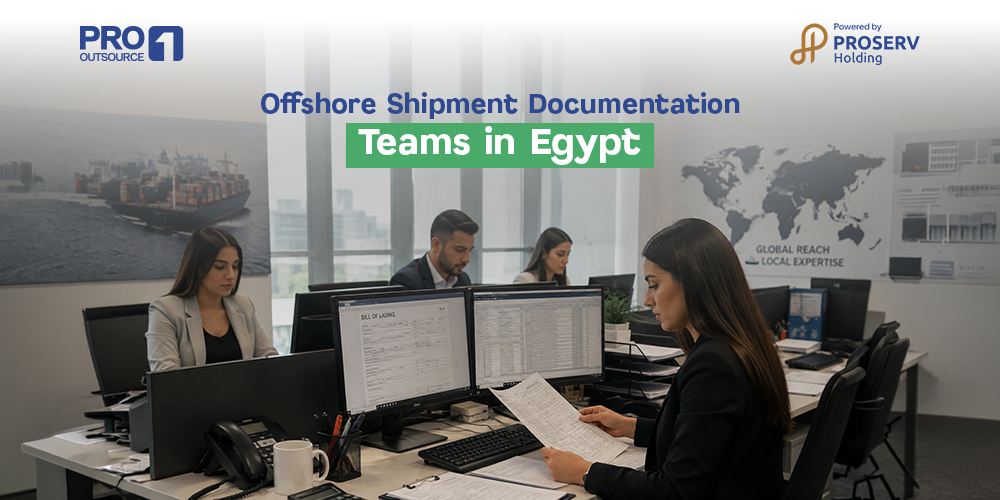
Building an offshore shipment documentation team in Egypt gives logistics companies a structured way to manage these back-office activities through a dedicated team.
The offshore team can support daily documentation, data entry, shipment record updates, coordination, and reporting while the logistics company maintains control over its systems, procedures, and operational standards.
What Is an Offshore Shipment Documentation Team?
An offshore shipment documentation team is a dedicated group of employees based in another country who support the administrative side of logistics operations.
For GCC transportation and logistics companies, Egypt can serve as a base for building a specialised team responsible for document processing and operational support.
The team works according to the company’s procedures and may use the same systems, templates, reporting structures, and communication channels as the internal operation.
Depending on the company’s requirements, the offshore team may handle:
- Shipment data entry
- Document verification
- Delivery record updates
- Invoice and reference number entry
- Customer file updates
- Shipment status reporting
- Coordination with internal teams
- Digital document organisation
- Daily and monthly operational reports
This allows the local team to concentrate on activities that require direct market presence or operational decision-making.
Why Shipment Documentation Requires Dedicated Support
Each shipment can generate multiple documents and data points.
The logistics company may need to manage:
- Booking details
- Collection information
- Delivery schedules
- Shipment references
- Customer instructions
- Driver or carrier information
- Customs-related documents
- Proof of delivery
- Invoices
- Internal operational records
When shipment volumes are low, these tasks may be handled by a small internal team. As the operation grows, the same employees may struggle to maintain accuracy and speed.
Documentation delays can lead to outdated shipment records, missing information, slow customer responses, and difficulties preparing operational reports.
A dedicated offshore team creates a clearer division of responsibilities and gives documentation tasks consistent daily attention.
Shipment Data Entry
Data entry is one of the most important functions within logistics back-office operations.
The offshore team can enter shipment information into the company’s systems based on documents, emails, booking forms, or instructions received from the operational team.
This may include:
- Customer names and account details
- Shipment reference numbers
- Origin and destination information
- Collection and delivery dates
- Vehicle or carrier information
- Service type
- Package or cargo details
- Operational notes
- Billing references
Accurate data entry supports the entire logistics process. It helps operational employees access correct information and reduces the need to search across emails or separate files.
Document Verification and Organisation
Receiving a document does not always mean that the file is complete or ready to use.
An offshore shipment documentation team can review documents against defined checklists and identify missing information before the file moves to the next stage.
The team may verify whether:
- Required fields are completed
- Reference numbers match
- Customer information is correct
- Delivery documents are attached
- Dates are entered consistently
- Supporting documents are available
- Files are stored under the correct shipment record
This process improves documentation consistency and helps reduce avoidable errors.
The team can also organise digital files according to the company’s naming and storage procedures, making documents easier to retrieve when needed.
Updating Shipment Status Records
Logistics companies depend on accurate shipment status information.
An offshore team can update records based on information received from drivers, carriers, warehouses, branch offices, or internal operational staff.
Updates may include:
- Shipment booked
- Collection scheduled
- Shipment collected
- In transit
- Arrived at facility
- Out for delivery
- Delivered
- Delayed
- Awaiting documentation
- Closed
Keeping these records updated gives customer service, finance, and management teams better visibility into the operation.
The offshore team does not make operational decisions unless authorised. Its role is to process and organise information according to the company’s procedures.
Proof of Delivery Processing
Proof of delivery is an important document for transportation and logistics companies.
Once a shipment is delivered, the related document may need to be received, reviewed, uploaded, and connected to the correct shipment record.
An offshore team can support this process by:
- Receiving digital proof-of-delivery documents
- Matching them with shipment references
- Checking whether required information is visible
- Uploading files into the company’s system
- Updating the shipment status
- Flagging missing or unclear documents
- Preparing delivery completion reports
This reduces the administrative burden on employees working directly with customers, drivers, or carriers.
Supporting Customer Service Teams
Customer service teams often spend time searching for shipment information before responding to customers.
When documentation and shipment records are updated consistently, customer service employees can access information more quickly.
An offshore documentation team can support customer service by maintaining:
- Current shipment status
- Delivery confirmation
- Shipment reference details
- Document availability
- Operational notes
- Escalation records
The team may also prepare information for customer service employees without communicating directly with customers unless that function is included in the agreed scope.
This gives the customer-facing team better access to organised and current information.
Invoice and Billing Support
Shipment records often need to be completed before an invoice can be prepared or reviewed.
Missing references, delivery documents, or service information can delay billing.
An offshore team can support finance and billing processes by organising the documents and data needed for invoice preparation.
This may include:
- Confirming shipment completion
- Matching delivery documents with records
- Entering billing references
- Organising customer account information
- Identifying missing documents
- Preparing shipment lists for billing review
- Supporting invoice record updates
The finance team remains responsible for financial decisions and approvals, while the offshore team handles defined administrative activities.
Daily Operational Reporting
Logistics management needs regular visibility into shipment activity.
An offshore team can prepare reports based on the data available in the company’s systems.
Common reports may include:
- Daily shipment volumes
- Completed deliveries
- Delayed shipments
- Missing documents
- Pending proof-of-delivery files
- Open records
- Data entry backlogs
- Customer account activity
- Documentation completion rates
These reports help managers identify operational issues and monitor the performance of both the offshore team and the wider logistics process.
Building Clear Workflows
An offshore documentation team should not operate without defined procedures.
The logistics company needs to establish clear workflows that explain:
- Which documents the team receives
- How information should be entered
- Which systems should be used
- When an issue should be escalated
- Who approves completed work
- Which reports should be prepared
- How quality should be measured
Clear workflows reduce confusion and make team performance easier to evaluate.
They also support consistent output when new employees join the offshore team.
Setting Key Performance Indicators
Offshore shipment documentation teams can be managed through measurable performance indicators.
Relevant KPIs may include:
- Number of records processed
- Document completion rate
- Data entry accuracy
- Average processing time
- Number of missing documents identified
- Reporting completion rate
- Backlog volume
- Error correction rate
- Service-level compliance
The correct KPIs depend on the team’s responsibilities.
For example, a team focused on proof-of-delivery processing should not be evaluated using the same measures as a team focused on shipment booking data.
Maintaining Quality Control
Documentation accuracy is critical in logistics operations.
A wrong reference number, incorrect delivery date, or missing file can affect billing, customer service, and operational reporting.
Quality control may include:
- Document checklists
- Record sampling
- Supervisor reviews
- Error tracking
- Daily reconciliation
- Regular feedback
- Refresher training
- Monthly performance reviews
A structured quality process helps the offshore team maintain consistent output as shipment volumes increase.
Protecting Operational Control
Building an offshore team does not mean transferring control of the logistics operation.
The transportation or logistics company continues to determine:
- Which systems are used
- How records are processed
- Which procedures the team follows
- What access employees receive
- How quality is measured
- Which issues require escalation
- Who approves changes
- How reports are presented
The offshore team carries out defined tasks under the company’s operating model.
This gives the business additional capacity without changing who controls the operation.
How PRO 1 Outsourcing Builds Offshore Logistics Teams
PRO 1 Outsourcing supports GCC companies in building dedicated offshore and back-office teams in Egypt.
For transportation and logistics companies, the team can be structured around specific documentation and operational support requirements.
PRO 1 Outsourcing can support the process through:
- Defining the required team structure
- Identifying suitable roles
- Recruiting and assessing candidates
- Managing employee onboarding
- Providing operational supervision
- Monitoring attendance and performance
- Preparing regular reports
- Supporting workforce administration
- Maintaining governance and documentation
The logistics company continues to define the workflows, systems, service standards, and expected outcomes.
PRO 1 Outsourcing manages the offshore team structure and provides the operational and administrative support needed to keep the team organised.
A More Efficient Documentation Process
Shipment documentation is essential, but it can consume valuable time when it is handled by employees who are also responsible for operational decisions, customer communication, or business development.
An offshore shipment documentation team gives logistics companies a dedicated resource for processing documents, updating records, organising files, and preparing reports.
With clear procedures, measurable KPIs, quality control, and consistent supervision, the team can support higher shipment volumes without placing unnecessary pressure on the company’s core operation.
Through PRO 1 Outsourcing, transportation and logistics companies can build a specialised back-office team in Egypt while maintaining full control over their systems, standards, and operational decisions.